Home | People | Research | Projects | Publications | Lab | Lab Safety | Admissions | Recruitment | Downloads | 中文
Research background
Shale reservoirs are dominated by nanoscale pores and contain densely spaced microfractures, so their transport and recovery mechanisms cannot be described by conventional reservoir theories. This direction builds the pore-to-reservoir chain of mass-transport mechanisms for shale systems.
1 Methane diffusion in nanopore throats
We proposed a geometric model that reproduces converging-diverging pore-throat features while remaining simple and general, and used molecular dynamics to study methane diffusion: throats narrower than 20 Å significantly affect the diffusion coefficient, and a critical throat width set by the energy barrier at the throat controls whether methane can diffuse through. Water and CO2 locally accumulate in throats and reduce methane diffusion (20 mol% water lowers diffusion by about 26%); residual water can completely block throats and interrupt pressure-driven flow. Residual water widens the pore-size range over which diffusion dominates, explaining shale gas production under irreducible-water conditions (SPE Journal 2022).
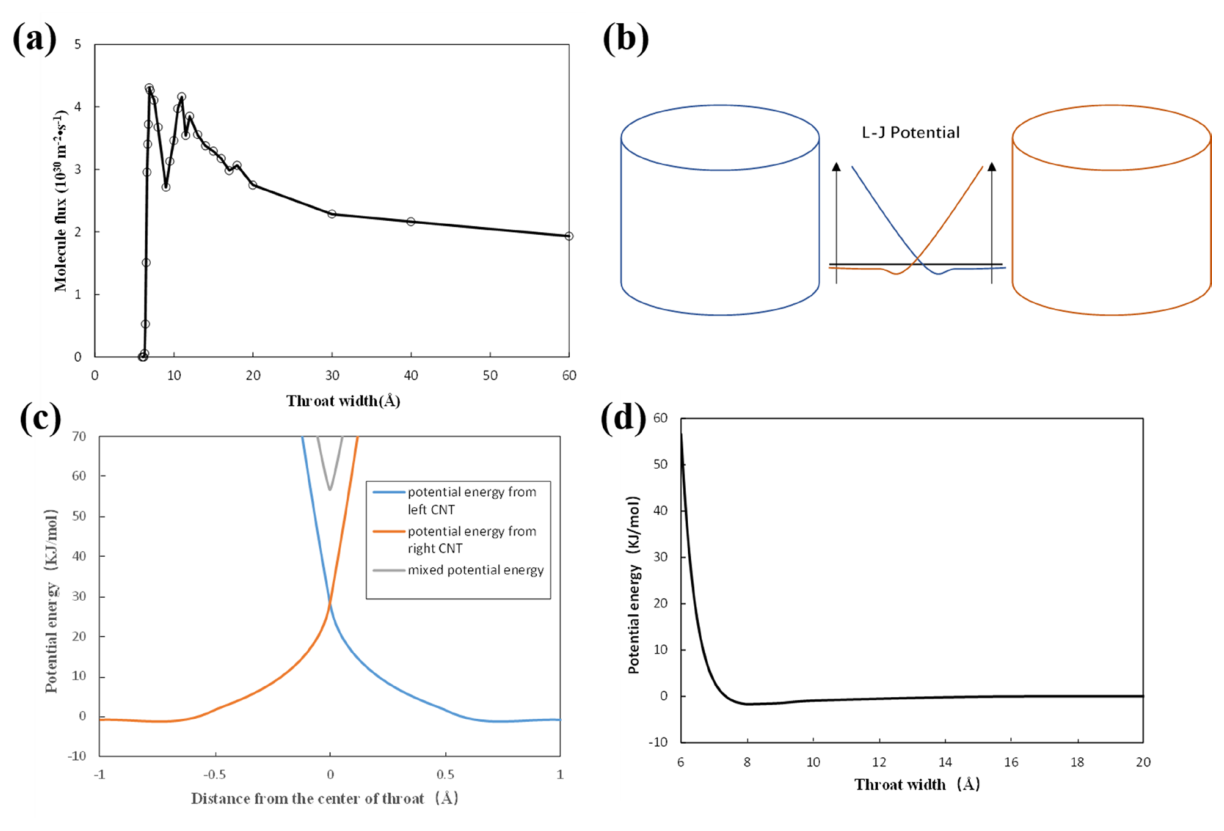
Fig. 1 Methane diffusion in the pore-throat structure and critical throat width analysis (SPE J. 2022, Fig. 2)
2 Imbibition recovery and REV-scale modeling in densely microfractured reservoirs
For the densely spaced parallel microfractures of continental shale, fine-grid simulation and analytical derivation show that countercurrent imbibition proceeds in two stages: adjacent fractures are independent early on and become strongly coupled by capillarity later. Cumulative oil production follows t1/2 in both stages but with very different pre-factors, and the late stage dominates recovery. Matrix permeability contributes little in the late stage — the matrix mainly stores fluid; the classical dual-porosity model substantially overestimates fracture-matrix exchange near the displacement front. REV-scale reservoir simulation of densely microfractured systems requires anisotropic relative permeability (SPE Journal 2024).
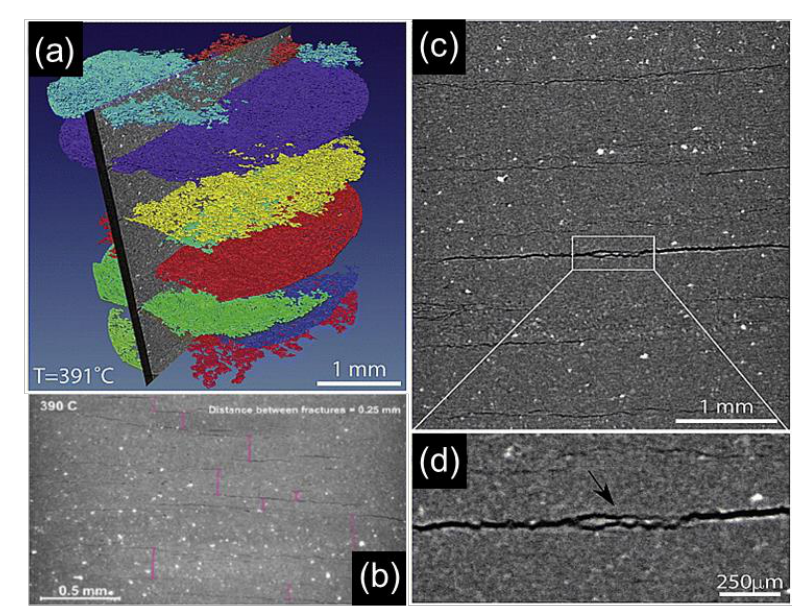
Fig. 2 X-ray tomography of dense and parallel microfractures in shale (SPE J. 2024, Fig. 1)
3 Trapping and startup dynamics of discrete fluid ganglia
Under a quasi-statically increasing external field, capillary-trapped ganglia first undergo irreversible discrete restructuring without moving; once the field reaches the criterion they start to migrate in sequential non-equilibrium jumps. The startup process markedly reduces capillary hysteresis: a static ganglion of fixed volume otherwise has multiple metastable configurations, yet before startup it normalizes to a unique "kick-off" state whose morphology and thermodynamic properties fall in a narrow range independent of volume. This makes the startup criterion analytically solvable and simplifies multiphase flow modeling for gas flooding, foam flooding, and other enhanced recovery techniques (Chemical Engineering Science 2024).
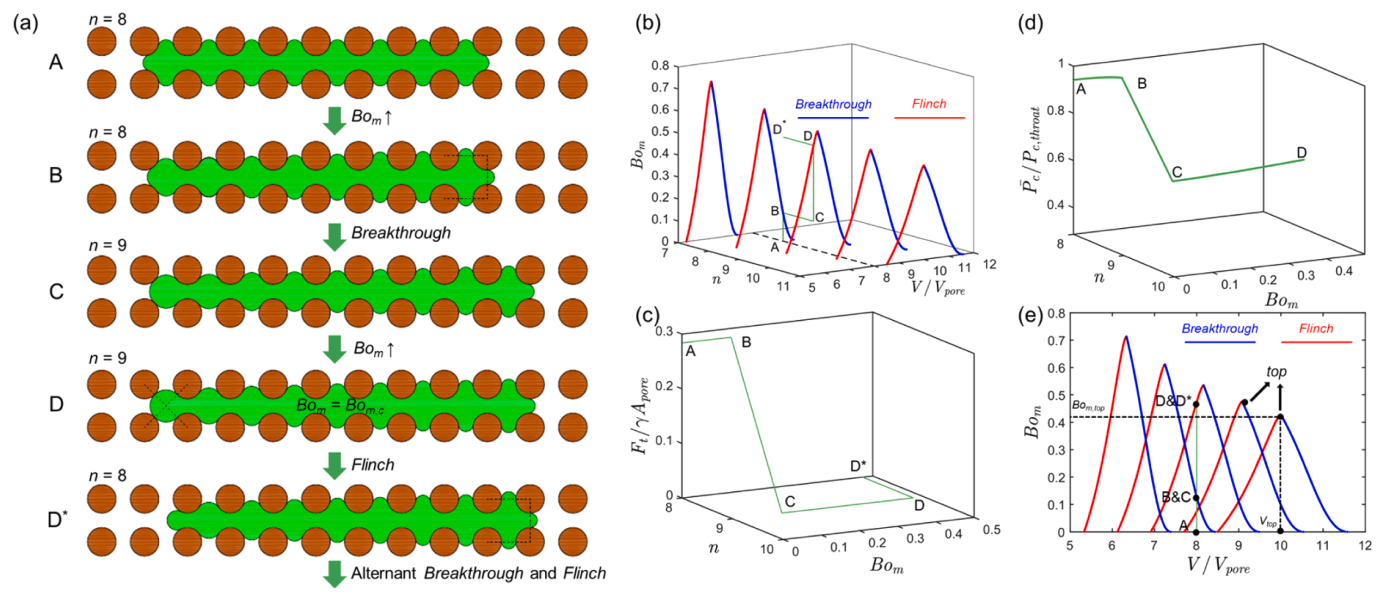
Fig. 3 Morphologic evolution and startup of a ganglion under an increasing external field (Chem. Eng. Sci. 2024, Fig. 2)
Papers
Runxuan Sun, Ke Xu*, Tianjia Huang, Dongxiao Zhang*. 2022. “Methane diffusion through nanopore-throat geometry: A molecular dynamics simulation study”. SPE Journal 27(4). https://doi.org/10.2118/212289-PA
Fei Yu, Rujun Han, Ke Xu*. 2024. “Countercurrent imbibition in porous media with dense and parallel micro-fractures: Numerical and analytical study”. SPE Journal. https://doi.org/10.2118/223094-PA
Chuanxi Wang, Ke Xu*. 2024. “Ganglion startup in porous media”. Chemical Engineering Science 292: 119982. https://doi.org/10.1016/j.ces.2024.119982
This page was compiled from the group’s publications with AI assistance.