Home | People | Research | Projects | Publications | Lab | Lab Safety | Admissions | Recruitment | Downloads | 中文
3 Multiphase Flow Theory
3.1 Bubbles in porous media: occurrence, ripening mechanisms, and thermodynamic stability
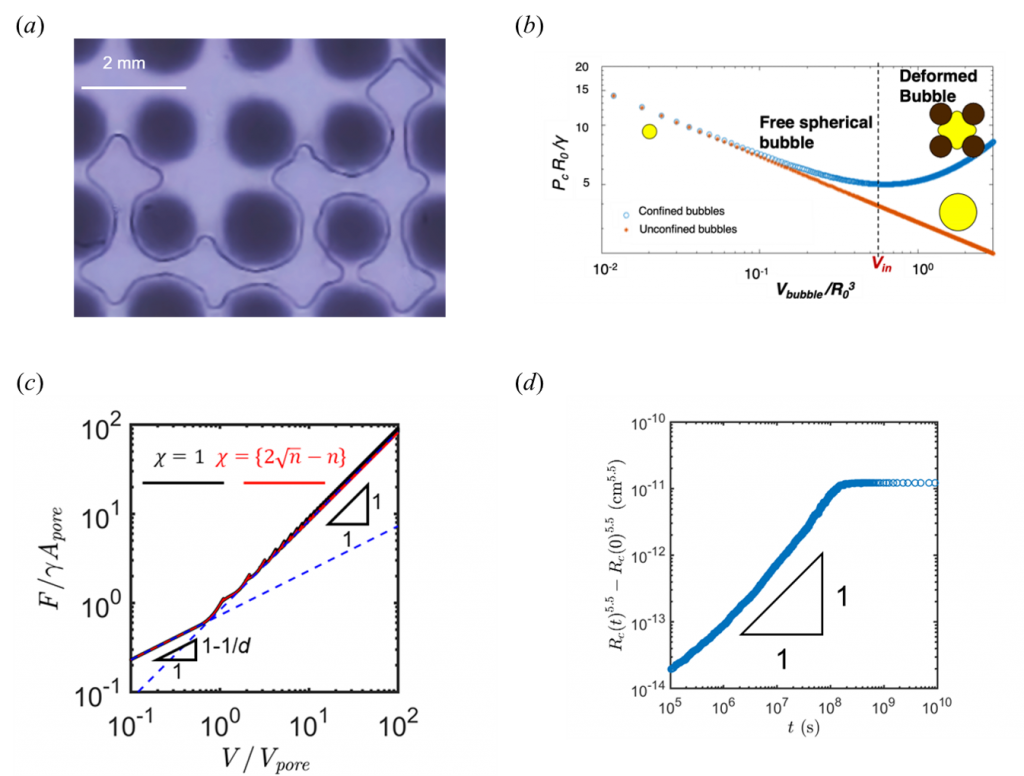
Dispersed-phase fluids (bubbles, droplets, etc.) are ubiquitous in porous media. Owing to the geometric constraints of pores and throats, bubbles are squeezed and reshaped (Fig. a), and the way capillary forces vary with bubble size is reversed (Fig. b); moreover, pore-scale capillary forces are strong, so many counter-intuitive phenomena arise. For example, subsurface sediments contain large amounts of dispersed-phase fluid with extremely high surface free energy, yet it remains trapped in porous media over long periods — exactly opposite to the open-space rule that bubbles spontaneously reduce surface free energy through coalescence and coarsening. The community had not previously offered a widely accepted explanation for this.
We build conceptual models and attack the problem from both kinetic and thermodynamic perspectives (Figs. c and d), combined with micron-scale bubble ripening experiments (Fig. a), to explore the evolution of dispersed-phase fluids in porous media bottom-up, and finally upscale to the formation scale to study how gravity and other external fields affect bubble-population ripening. We hope to provide a solid theoretical foundation for scientific and engineering problems such as geologic CO2 storage, oil and gas recovery, and the improvement of advanced battery systems.
3.2 Emulsion flow in porous media
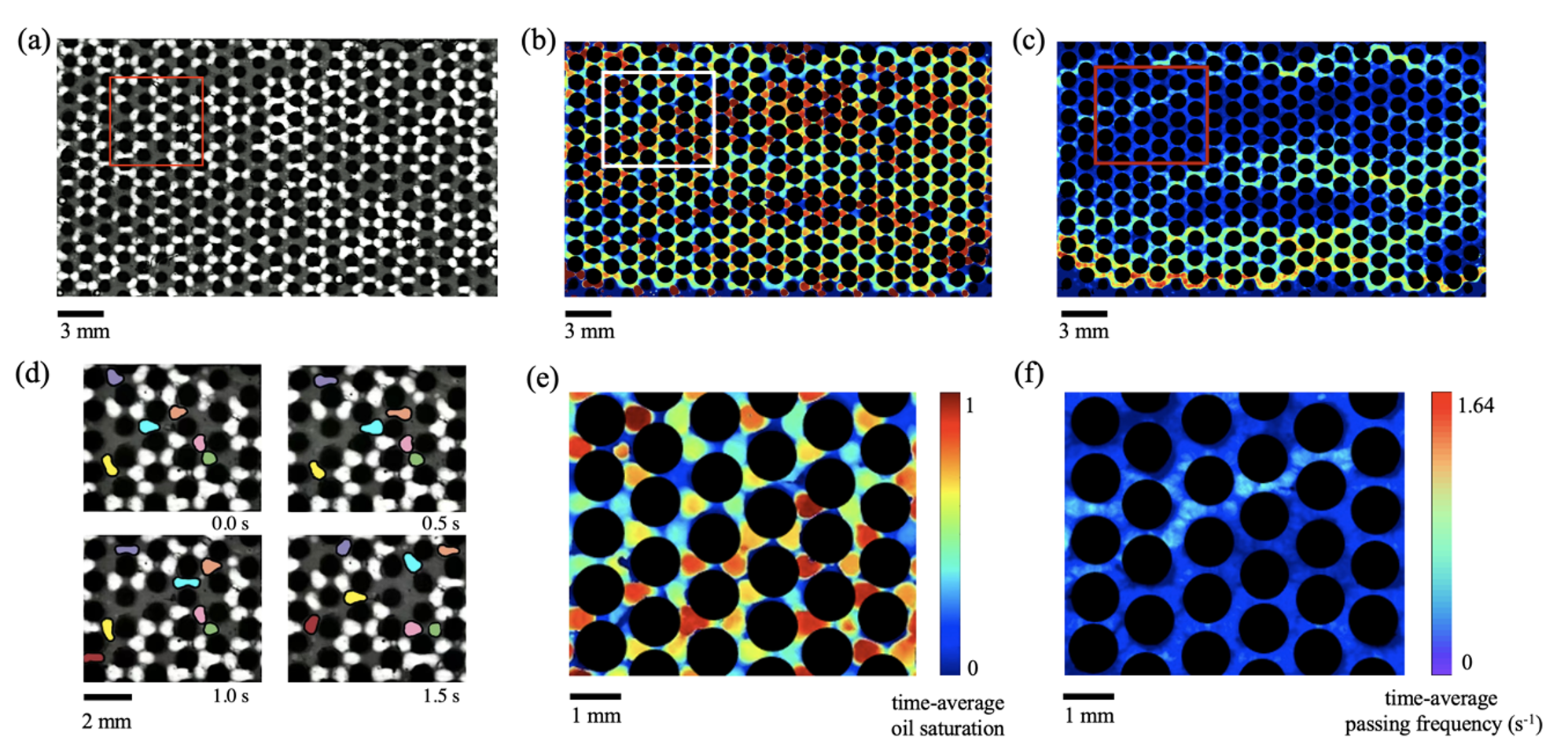
Understanding emulsion flow in porous media is important for enhanced oil recovery and the remediation of contaminated soils. Many previous studies relied on conventional emulsion preparation methods and focused on the relation between flow rate and pressure drop in three-dimensional cores, paying little attention to how droplets deform while passing through pore throats; as a result, the mechanics of emulsion flow in porous media lacked a systematic explanation.
Using microfluidic visualization, our experiments concentrate on straight channels and single-droplet behavior. We found that when a single droplet is larger than the throat width and passes only one throat at a time, the droplet flow regime changes with increasing capillary number, and different droplet flow behaviors lead to different trends of emulsion flow pressure versus capillary number, for which we obtained corresponding mathematical models.
We hope these findings help explain previously observed phenomena of emulsion flow in porous media from a physical-mechanism perspective — such as preferential channels (shown in the figure above) and shear thinning — and provide a stronger theoretical basis for engineering problems involving emulsion flow.
3.3 Coupled flow, mass transfer, and heat transfer in near-fracture porous media
After the United States and Russia vigorously developed shale oil and gas resources, China has become the third largest shale oil country. China’s shale oil reserves are abundant, mostly continental shale oil, but exploration and development started late. Recently, a major strategic breakthrough in Gulong shale oil exploration at the Daqing Oilfield has pushed the shale oil revolution to a climax.
Shale oil development differs from conventional oil and gas development. CO2 huff-and-puff has long been considered a method to improve shale oil recovery efficiency, and CO2 miscible flooding is an effective way to enhance shale oil recovery.
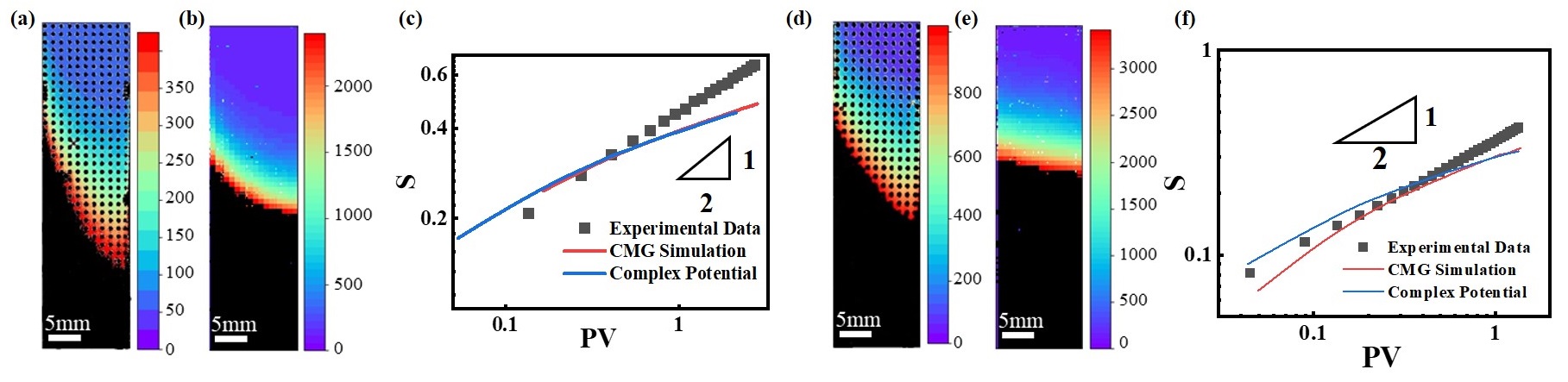
Targeting the densely developed microfractures in shale reservoirs (1,000–3,000 per meter), we propose the near-fracture porous media system to study the coupled flow, heat transfer, and mass transfer mechanisms, and thereby optimize shale oil recovery schemes.
Such near-fracture systems are also common in geologic CO2 storage: native fractures are well developed in near-surface saline aquifers, where intense CO2–water interfacial mass transfer brings energy changes; depleted reservoirs after fracturing contain abundant irregular fractures, and intense three-phase (oil–gas–water) interfacial mass transfer requires theoretical support.
Through experimental and theoretical analysis of the complex flow, mass transfer, and heat transfer phenomena in near-fracture porous media, we aim to provide a basis for efficient shale oil recovery, geologic CO2 storage, and related scientific problems.
3.4 Melting and convection of salt-overlain permafrost
In porous Hele-Shaw experiments, we studied how Rayleigh-Darcy convection regulates the morphology and rate of a melting front when salt water overlies permafrost: at low Rayleigh numbers the melting front develops fingering, while at high Rayleigh numbers the front remains stable — opposite to the classical expectation that higher Ra enhances instability in Rayleigh-Darcy convection. The interplay of two competing flow structures (front-perturbation-modulated local circulation and lateral chaotic mixing) determines the transition of melting regimes, and classical mass transfer theory significantly underestimates the melting rate. The results suggest that permafrost layers may become permeable earlier than previously predicted, with implications for methane release, carbon storage, and subsurface energy recovery.
Paper: Yumin Wang, Jin-Han Xie, Wei Yang, Xiaotian Li, Zulikaer Abulaiti, Shuai Zheng, Jingwei Zhu, Ke Xu*. 2025. “Permafrost thawing under overlaying salt water”. Science Advances 11: eadp2808. https://doi.org/10.1126/sciadv.adp2808
The English text of this page was translated from the Chinese page with AI assistance.